15 Salesforce Document Types That Drive Revenue
Category :
Document Generation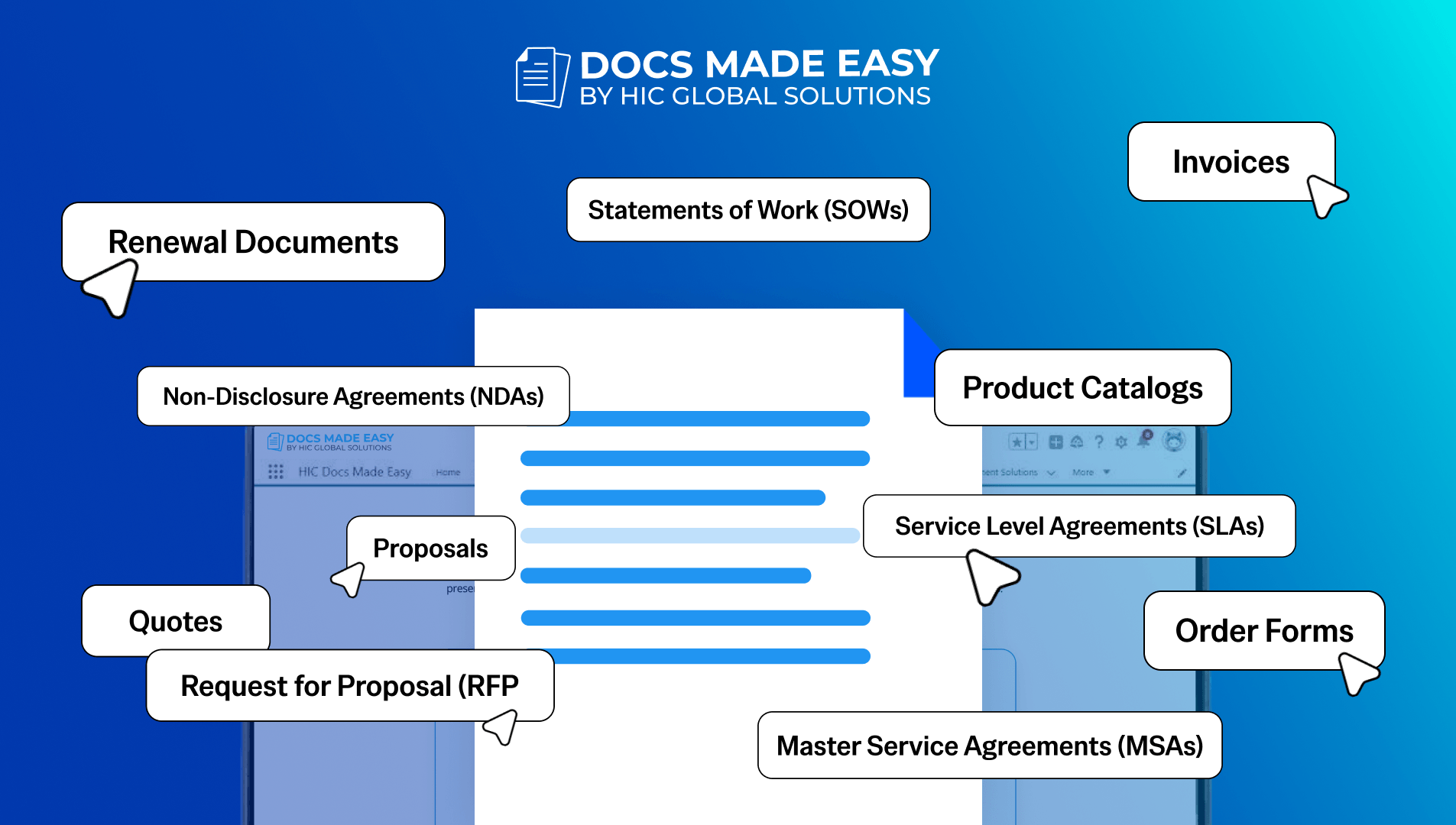
Docs Made Easy Proudly Featured by Salesforce
With Docs Made Easy, creating professional, Salesforce-powered documents is just a few clicks away.
Explore Now!Team work with documents almost every day, but many businesses still underestimate how much these documents actually affect revenue. A delayed quote, an incomplete contract, or a manually created invoice may look like a small issue at first, but over time these small delays slow down approvals, payments, and even customer onboarding.
And the thing is, most of this usually happens because teams are still handling too many documents manually.
That is why more companies are now improving their Salesforce document workflows and moving toward automation instead of depending on disconnected files, repeated editing, and manual document creation every single time.
According to Agentforce Revenue Management (formerly known as Revenue Cloud), businesses are increasingly shifting toward automated quote-to-cash processes to improve operational efficiency and reduce delays across sales workflows.
In this blog, we will go through the document types businesses regularly use inside Salesforce and how document automation, AI-driven workflows, and Salesforce document generation systems are helping teams move deals faster and manage sales operations more smoothly.
Why Salesforce Document Workflows Matter
Most sales processes involve much more than just customer conversations. Teams deal with quotes, proposals, contracts, invoices, approvals, onboarding files, and renewal paperwork almost continuously throughout the customer journey.
And when these processes stay manual for too long, things slowly become harder to manage properly.
Sometimes sales teams end up using older proposal versions. Sometimes invoices get delayed because information is sitting across multiple systems. And many times, approvals take longer simply because documents are not organized properly.
Research shared by McKinsey & Company Sales Research also explains how companies improving digital sales workflows and automation processes often achieve faster sales cycles and stronger operational efficiency.
So document workflows are no longer just administrative tasks anymore. They are directly connected with how quickly revenue moves through the business.
15 Salesforce Documents That Directly Impact Revenue
Quotes
A Salesforce quote is usually one of the first documents customers seriously review before moving ahead with a purchase.
It includes pricing, products, discounts, taxes, and commercial terms, so even small errors inside quotes can create confusion later during approvals.
Many businesses now automate Salesforce quote workflows directly inside CRM systems because manually preparing pricing documents again and again eventually slows teams down unnecessarily.
And honestly, during large sales cycles, automated quote workflows save a lot more time than most teams expect initially.
If you want to create a quote in Salesforce quickly and smoothly, check out this blog for a simple step-by-step guide.
Proposals
Proposals are still one of the most regularly used sales documents across almost every industry.
Sales teams use them to explain services, pricing structures, implementation plans, timelines, and expected outcomes for customers.
With Salesforce proposal generation systems, businesses can pull customer information directly from Salesforce instead of manually copying details into every proposal document.
That not only reduces repetitive work, but also helps teams send proposals much faster during active sales conversations.
Statements of Work (SOWs)
Statements of Work are commonly used in consulting, implementation, IT, and service-based businesses.
These documents usually explain:
- Project scope and expected deliverables
- Timelines and milestone expectations
- Responsibilities assigned to both teams
- Approval processes during project execution
Using Salesforce document generation for SOW creation helps businesses maintain consistency across projects while reducing delays during onboarding stages.
Master Service Agreements (MSAs)
MSAs are important for long-term customer relationships where services continue over an extended period of time.
These agreements generally define:
- Commercial relationship structures between both companies
- Legal terms and payment expectations
- Service responsibilities and operating conditions
- Rules that apply across future projects together
Because these agreements are detailed and often lengthy, businesses usually prefer document generation systems instead of drafting them repeatedly from scratch.
Non-Disclosure Agreements (NDAs)
NDAs are one of the most common legal documents used during early-stage business discussions.
Whenever businesses discuss confidential information, partnerships, pricing structures, or product details, NDAs usually become necessary before conversations move further.
Using legal document creation workflows inside Salesforce helps businesses generate and manage NDA approvals much more efficiently.
This also helps legal and sales teams stay aligned during sensitive customer discussions.
Order Forms
Order forms help businesses finalize purchases once pricing and product selections are approved.
These documents usually contain:
- Product quantities and pricing confirmations
- Customer billing and payment information
- Selected services or package details
- Final approval and authorization sections
Many companies now use AI document generation systems to create order forms automatically using Salesforce opportunity data.
This reduces delays during order processing and improves accuracy as well.
https://docsmadeasy.com/blog/how-to-create-an-invoice-in-salesforce/
Invoices
A Salesforce invoice process connected directly with CRM and billing systems helps businesses handle payments more smoothly, and if you’re looking to create invoices in Salesforce, this guide can help you get started.
Without automation, finance teams often spend unnecessary time creating invoices manually, checking records repeatedly, and correcting billing mistakes later.
Automated invoice workflows help businesses generate invoices using order details, subscriptions, completed services, or customer billing information already available inside Salesforce.
For businesses handling large transaction volumes, this becomes extremely important over time.
Renewal Documents
Recurring revenue businesses depend heavily on customer renewals.
And honestly, renewal management becomes difficult very quickly when businesses try to handle everything manually across spreadsheets or disconnected systems.
Automated renewal documents help businesses send updated pricing, contract extensions, and renewal approvals before agreements expire.
This gives account managers better visibility while also improving retention processes.
Service Level Agreements (SLAs)
Enterprise customers usually expect clear service commitments before signing agreements.
SLA documents define things such as:
- Expected support response timelines
- Service availability commitments
- Escalation procedures during critical situations
- Performance expectations for support teams
Using Salesforce document generation helps businesses prepare these documents faster while keeping service expectations standardized across customers.
Product Catalogs
Sales conversations often require supporting product information during presentations and customer evaluations.
Businesses use document automation systems to generate:
- Product catalogs with updated details
- Technical specifications for customer reviews
- Product comparison sheets for sales discussions
- Service overviews and feature documents
This helps sales teams avoid sharing outdated information during active opportunities.
Request for Proposal (RFP) Responses
RFP responses usually take a large amount of coordination because multiple departments are involved in approvals, pricing, legal reviews, and technical responses.
Without organized workflows, teams often spend too much time rebuilding the same information repeatedly.
Using Salesforce document generation helps businesses reuse approved content and generate RFP responses faster without creating everything manually every time.
This becomes especially useful for enterprise sales teams managing frequent procurement requests.
Contracts
A Salesforce contract usually becomes the central document once deals move closer toward final approval stages.
Contracts often include legal terms, pricing agreements, responsibilities, renewal conditions, and service expectations between both parties.
The difficult part is that contracts rarely stay unchanged. They usually go through multiple reviews, revisions, and approval rounds.
Because of this, businesses increasingly rely on document automation systems to manage version tracking and reduce manual editing work.
To create a contract in Salesforce quickly and without manual back-and-forth, go through this blog for a simple step-by-step guide.
Billing Statements
Usage-based pricing models often require businesses to generate detailed billing statements for customers.
These documents help customers understand:
- Service usage and consumption details
- Billing calculations and subscription charges
- Additional fees or adjustments applied
- Payment summaries and invoice breakdowns
Automated billing workflows also improve financial visibility for both businesses and customers.
Compliance Documents
Industries like healthcare, insurance, finance, and legal services depends on compliance documentation before sales processes can be completed properly.
Legal document creation workflows help businesses generate:
- Regulatory approval documentation
- Compliance verification forms
- Policy acceptance agreements
- Industry-specific disclosure documents
Keeping these workflows connected with Salesforce helps businesses manage approvals and records more efficiently.
Executive Summaries
Enterprise proposals often become too long for leadership teams to review in detail.
That is why executive summaries are commonly used to highlight the most important information quickly.
These summaries usually include:
- Key business outcomes and recommendations
- Pricing and implementation highlights
- Commercial overviews for stakeholders
- Important next steps and approvals
AI document generation tools now help businesses prepare executive summaries much faster using existing CRM and proposal data.
According to Gartner Sales Technology Insights, organizations are increasingly adopting AI-driven sales technologies and automation systems to reduce administrative work and improve sales productivity.
How AI Document Generation Is Changing Sales Workflows
Document processes are changing quite a bit now compared to how businesses handled them earlier.
Instead of using static templates and manually editing every document, companies are increasingly using AI document generation systems connected directly with Salesforce data.
This helps businesses:
- Reduce repetitive document preparation work
- Improve consistency across customer documents
- Personalize proposals and agreements faster
- Speed up internal approvals and onboarding
For larger businesses managing hundreds of documents every month, these changes make a very noticeable difference operationally.
Why Document Automation Matters More Now
As businesses grow, document management usually becomes more complicated naturally.
More deals mean more approvals, more contracts, more invoices, and more customer communication happening simultaneously.
Using document automation helps businesses:
- Keep sales processes more organized overall
- Reduce manual administrative workload significantly
- Improve collaboration between legal and sales teams
- Accelerate quote-to-cash operational workflows
And over time, this also helps businesses avoid delays that normally slow revenue movement.
If you want to understand the complete impact of Salesforce document automation in detail, you can explore our full blog on the topic.
To truly simplify this complexity, businesses need a solution built specifically for Salesforce-driven document workflows. That’s where Docs Made Easy fits naturally into the process.
Docs Made Easy Simplifies Salesforce Document Generation
Businesses looking for simpler Salesforce document workflows are increasingly using platforms built specifically for automation and CRM-connected document generation.
Docs Made Easy helps businesses manage:
- Salesforce document generation workflows
- Automated proposal and quote creation
- Salesforce contract management processes
- Salesforce invoice generation workflows
- AI document generation and template automation
The platform has also been recognized by Salesforce in recent discussions around productivity and automation solutions for CRM environments.
If you want to generate your first document in Salesforce, check out this quick demo video to see how it works:
Final Thoughts
Documents influence almost every important stage of the sales cycle, even though businesses sometimes treat them like simple administrative tasks.
Quotes, proposals, contracts, invoices, onboarding documents, renewals, and approvals all directly affect how quickly deals move and how smoothly customers experience the process.
When businesses continue managing these workflows manually for too long, delays and operational inefficiencies slowly start affecting revenue performance as well.
Using Salesforce workflow automation together with document automation systems helps businesses create faster, cleaner, and more scalable sales operations.
And as AI document generation continues growing across CRM systems, businesses are moving toward much more connected and efficient document processes overall.
Businesses looking to simplify Salesforce proposal generation, quote workflows, invoice management, or generate any document within Salesforce can explore Docs Made Easy and install the solution designed specifically for modern document management workflows.
Frequently Asked Questions
Related Blogs
Top 7 Benefits of Integrating Docs Made Easy with Salesforce Revenue Cloud
Managing revenue today involves much more than creating quotes and sending contracts. Businesses need a connected process that handles pricing,…
Salesforce Documentation Best Practices: How to Reduce Admin Dependency and Scale Faster
As businesses grow in Salesforce, managing documentation often becomes difficult. At first, teams can easily manage workflows, approvals, automations, and…
The Future of AI in Salesforce Document Generation
For the longest time, documents were treated as endpoints. You completed a process, generated a file, and moved on. The…